



Carry-on baggage sizes in CabinFit’s dated catalogue cohort

CabinFit analyzed one catalogue-qualified official-source carry-on record per airline at a fixed cutoff. The report separates current field-scoped evidence from legacy catalogue metadata.

Download the CSVAnalysis cutoff: Sep 13, 2026

Included record dates span: Aug 7, 2026–Sep 13, 2026. 12/81 have current field-scoped dimension evidence; other evidence states are listed in the CSV.

The headline findings

55 × 40 × 23 cm

is the most frequently published carry-on size in this dataset.

86.4%

of analyzed airlines have a recorded numeric per-piece weight limit; the median among those records is 8 kg.

29 + 51

The sample includes both low-cost and full-service carriers, so a single ‘standard cabin bag’ does not fit every policy.

How common suitcase sizes compare

A dimensional match is not an allowance guarantee. Fare, route, aircraft, weight and ticket conditions can still change the outcome.

HTML embed · How common suitcase sizes compare

Most common published dimensions

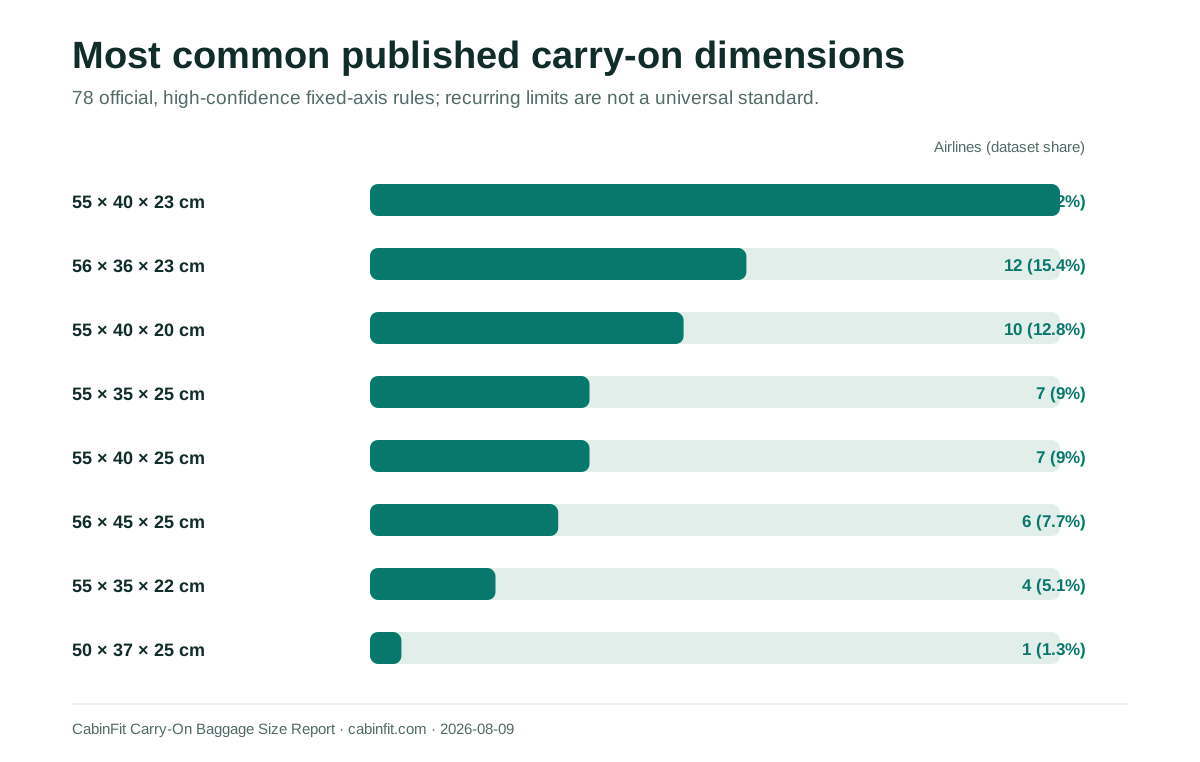
These are recurring maximum dimensions in the dated catalogue cohort, not a universal standard or proof of current field review for every row.

HTML embed · Most common published dimensions

81

airlines analyzed

81

rules flagged official and high-confidence in the catalogue

7

regions represented

86.4%

have a recorded numeric per-piece weight limit

How common suitcase sizes compare

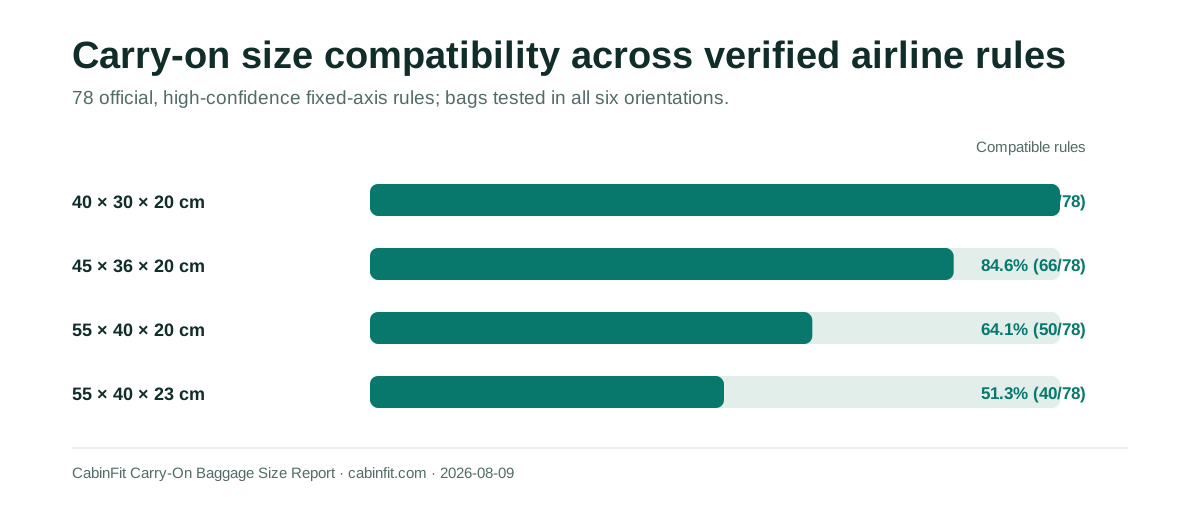
Each preset is tested against every analyzed dimensional limit in all six possible bag orientations.

Bag sizeAirlinesCompatibility
40 × 30 × 20 cm81/81
100%
45 × 36 × 20 cm69/81
85.2%
55 × 40 × 20 cm53/81
65.4%
55 × 40 × 23 cm43/81
53.1%

A dimensional match is not an allowance guarantee. Fare, route, aircraft, weight and ticket conditions can still change the outcome.

Most common published dimensions

These are recurring maximum dimensions in the dated catalogue cohort, not a universal standard or proof of current field review for every row.

55 × 40 × 23 cm

24 · 29.6%

29.6%

56 × 36 × 23 cm

12 · 14.8%

14.8%

55 × 40 × 20 cm

10 · 12.3%

12.3%

55 × 35 × 25 cm

7 · 8.6%

8.6%

55 × 40 × 25 cm

7 · 8.6%

8.6%

56 × 45 × 25 cm

6 · 7.4%

7.4%

55 × 35 × 22 cm

4 · 4.9%

4.9%

50 × 37 × 25 cm

1 · 1.2%

1.2%

55 × 40 × 20 cm → 55 × 40 × 23 cm

What does 3 cm of extra depth cost?

Using the exact same airline cohort, compare a 55 × 40 × 20 cm bag with a 55 × 40 × 23 cm bag. Because the second bag contains the first, its compatibility can only stay equal or fall.

10 fewer airline limits accept the deeper bag

53/81 (65.4%) → 43/81 (53.1%); −12.3 pp.

Air Arabia, Air China, Air India, Asiana Airlines, Hainan Airlines, Icelandair, Korean Air, Ryanair, TAROM, Vueling.

Compare airlines

Coverage by airline region

Regional totals describe the dataset composition and should not be read as market share.

RegionAirlines
Europe38
Asia17
North America11
Middle East7
Latin America4
Oceania3
Africa1

Methodology and inclusion rules

For the same catalogue revision, the version 2 cohort is fixed at 13 September 2026. It uses the launch/index-eligible subset, requires airline and rule record dates within the preceding 120 days, and selects the lowest rule ID when more than one eligible three-axis carry-on rule exists. Official-source and high-confidence catalogue flags do not by themselves prove a current field-by-field review.

Compatibility is dimensional only. CabinFit rotates each test bag through six orientations and counts a match when one orientation stays within all three published limits.

Weight, fare inclusion and conditions are descriptive fields with their evidence status exported separately. A missing weight may be unrecorded or unreviewed; it never means unlimited weight. Combined-cabin limits are excluded from per-piece weight statistics.

Methodology and inclusion rules

Sep 13, 2026

Look inside the same dated cohort

These cuts reuse the 13 September 2026 analysis cutoff. They describe CabinFit catalogue records, not a fresh airline survey or market share.

Regional size comparison

The denominator is the report's carry-on cohort within each region. Small groups and mixed evidence limit generalization.

RegionRules55 × 40 × 20 fits55 × 40 × 23 fitsDimensions field-reviewed
Europe3835/3831/388/38
Asia178/173/170/17
North America115/115/112/11
Middle East73/72/71/7
Latin America40/40/41/4
Oceania31/31/30/3
Africa11/11/10/1

Personal-item rules in the same airline set

Only airlines already in the carry-on cohort with a separate, eligible official-source personal-item record are counted. Missing records are unknown, not evidence that a personal item is prohibited.

54/81

54 of 81 airlines have an eligible fixed-axis personal-item record; 12 have field-scoped dimension evidence.

Download personal-item subset CSV

Recorded fare mapping

These are stored base-rule categories, not a promise that a specific ticket includes the bag. Field-scoped fare evidence is shown separately; check the booking and official source.

MappingCarry-onPersonal item
Included4851
Not included00
Conditional323
Varies10
Unknown00
Fare field-reviewed12/8112/54

Data changelog

Material dataset and publishing changes are recorded here so citations remain auditable.

  1. Version 2.1.0

    Sep 22, 2026

    Added regional compatibility, a same-airline personal-item subset, and fare-mapping slices without moving the 13 September analysis cutoff.

  2. Version 2.0.0

    Sep 13, 2026

    Pinned cohort eligibility to an explicit analysis cutoff, disclosed field-review coverage and record-date range, and added the 20 cm versus 23 cm depth question.

  3. Version 1.2.0

    Sep 13, 2026

    Excluded explicitly combined cabin-weight limits from per-piece weight statistics and added weight scope and cabin variants to the CSV export.

  4. Version 1.1.0

    Aug 9, 2026

    Added downloadable SVG charts, citation-ready filenames, and a public methodology changelog.

  5. Version 1.0.0

    Aug 9, 2026

    Published the first airline-level dataset using official, high-confidence, fixed-axis carry-on rules.

CSV · 81 rows

Use the underlying data

Download the fixed-cutoff airline-level CSV with dimensions, weight scope, field-evidence status, fare metadata, source URLs and record dates.

Download the CSV

Download citation-ready charts

Editable SVG files include the report title, method note, date and CabinFit attribution.

Embed a live bag-size tool

How to cite this report

CabinFit, “Carry-On Baggage Size Report 2026,” version 2.1.0, analysis cutoff 13 September 2026; include your access date.

https://getcabinfit.com/research/carry-on-baggage-size-report#cite-this-report

Sample of included airline sources

Every row links to its airline page. The CSV distinguishes current field-scoped reviews from legacy unscoped catalogue records.

Test your own bag against the data

Enter your packed outside dimensions or compare a bag across the airline directory.

Airline policies can change and may vary by ticket, route, cabin or aircraft. Always confirm your allowance with the airline before travel.