



On this page
Key takeaways
- One inch equals exactly 2.54 cm; the risk comes from rounding the result, not from the conversion factor.
- Dimension labels and order vary, so compare the three edges as a rotatable set unless the airline fixes an orientation.
- A listed size is normally an outside maximum, including fixed wheels and handles.
- Size, weight, fare inclusion and operating-carrier rules are separate checks; passing one does not pass the others.
Turn these limits into a real bag check
Enter your packed bag dimensions and compare them with the published airline rule. Choose the airline you are actually flying.
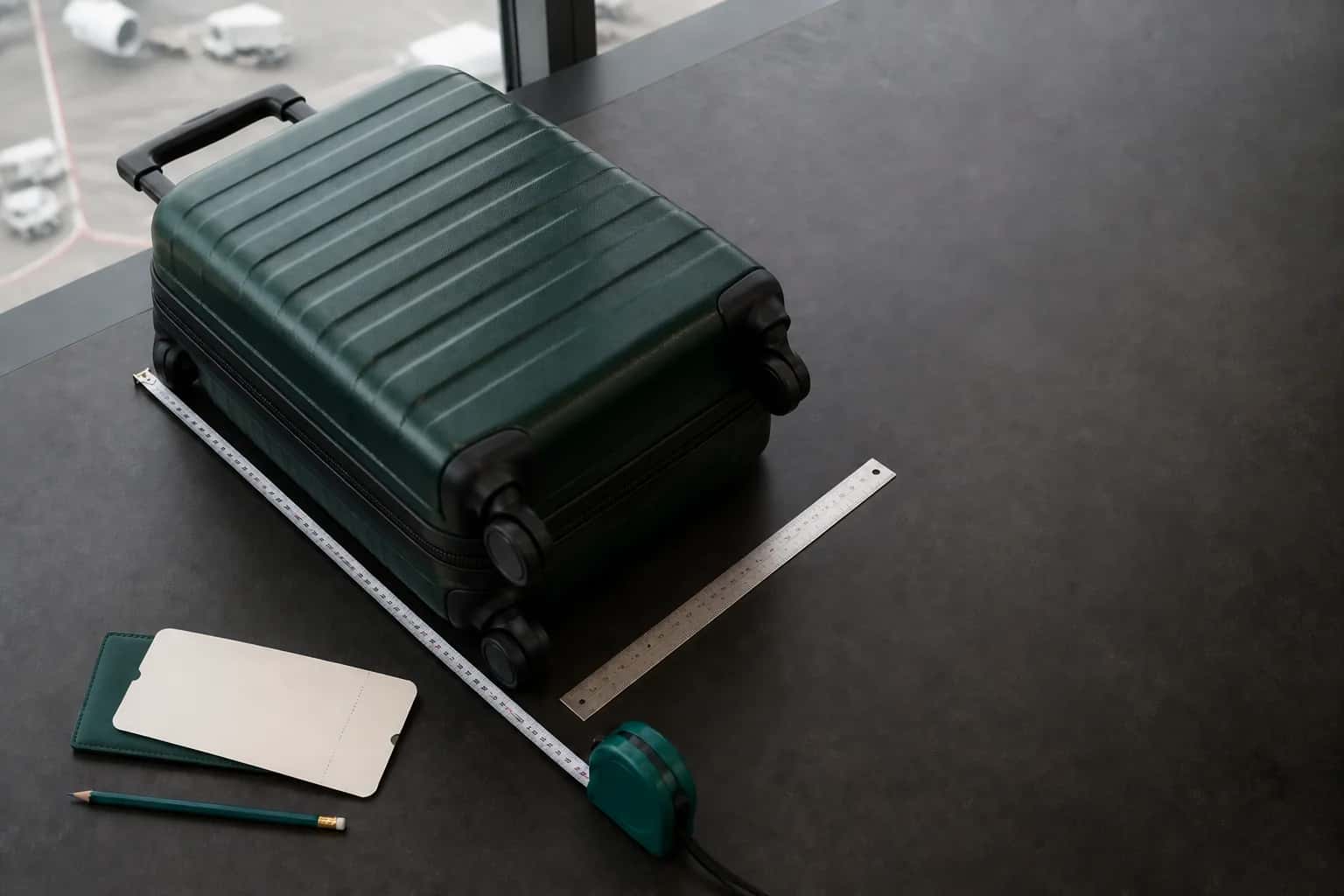
Measure the packed outside
Include wheels, handles, side pockets, and the shape your bag has when it is full.
- 01Pack the bag first, then measure it.
- 02Check your bag
- 03Compare all airlines
Length x width x height is not a universal order
Airlines describe the same rectangular bag as length x width x height, height x width x depth, or with diagrams that place the longest edge vertically. The labels are useful for understanding how a sizer is built, but a portable bag can normally be rotated. For a pure dimensional comparison, sort both sets from longest to shortest or test all six orientations.
Do not use rotation to ignore a real storage condition. A personal item must still go under the seat and an overhead bag must be stowable in the bin. Some shaped cases, instruments, pet carriers, or bags with fixed protrusions do not behave like a simple rectangular box.
Convert first, round last
NIST states that one international inch is exactly 25.4 millimeters, or 2.54 centimeters. Multiply inches by 2.54 to obtain centimeters; divide centimeters by 2.54 to obtain inches. The exact factor does not mean the airline's displayed conversion is exact. A carrier may publish 22 in as 55 cm even though the mathematical value is 55.88 cm.
When both units appear on the official page, treat the unit the airline uses as primary or ask the airline which sizer specification controls. Do not combine the most generous edge from the inch version with the most generous edge from the metric version. That creates a hybrid allowance the carrier never published.
- 22 x 14 x 9 in converts to 55.88 x 35.56 x 22.86 cm.
- 55 x 40 x 23 cm converts to about 21.7 x 15.7 x 9.1 in.
- Round for display only after the fit calculation; early rounding can flip a tight result.
- Keep at least one decimal place when diagnosing a near-limit bag.
Linear inches are a different rule
A three-edge maximum such as 55 x 40 x 23 cm limits every edge independently. A linear-size rule such as 45 linear inches adds length, width and depth. These rules are not interchangeable. A bag can satisfy the total while one edge is too long for a rectangular cabin sizer.
Linear totals are more common for checked baggage. The FAA describes 45 linear inches as a general carry-on reference for many airlines, but also tells travelers to check the airline's own maximum size and item count. When an airline publishes a rectangular limit, use the three-edge test rather than replacing it with a total.
Read the rule beyond the three numbers
A correct conversion can still produce the wrong travel decision. Read whether the dimensions include wheels and handles, whether a separate weight limit applies, whether the item is included in your fare, and whether route or aircraft exceptions exist. IATA notes that allowances can vary by airline, cabin class and aircraft type.
On a codeshare or connecting itinerary, identify the operating carrier for every segment. IATA's interline guidance says the operating airline establishes the maximum size and weight for carry-on items. Your booking brand and the aircraft operator can be different companies, so one bag may need to satisfy more than one policy.
Step by step
- 1
Copy the official three-edge limit
Use the operating airline's current baggage page and note the item type, fare condition, source unit, weight and check date.
- 2
Measure the finished packed bag
Include fixed wheels, handles, feet, filled pockets and bulges. Keep all three measurements in one unit.
- 3
Convert without early rounding
Use the exact 2.54 cm-per-inch factor and keep at least one decimal place until after the comparison.
- 4
Test every valid orientation
Compare all three edges, rotating the bag where physically reasonable, and treat one centimeter or less as tight.
- 5
Verify the non-size conditions
Check weight, fare inclusion, route, aircraft and operating carrier before relying on the result.
Airlines covered in this guide

United Airlines
- Personal Item
- 43 x 25 x 22 cm
- Standard, included
- Carry-on
- 56 x 35 x 23 cm
- Check fare conditions

American Airlines
- Personal Item
- 45 x 35 x 20 cm
- All cabins, included
- Carry-on
- 55 x 35 x 22 cm
- All cabins, included

JetBlue
- Personal Item
- 43 x 33 x 20 cm
- All fare families, included
- Carry-on
- 55 x 35 x 22 cm
- All fare families, included

Air Canada
- Personal Item
- 43 x 33 x 16 cm
- All fares, including Economy Basic, included
- Carry-on
- 55 x 40 x 23 cm
- Check fare conditions

Ryanair
- Personal Item
- 40 x 30 x 20 cm
- Basic, included
- Carry-on
- 55 x 40 x 20 cm
- Check fare conditions
- Max 10 kg

Turkish Airlines
- Personal Item
- 40 x 30 x 15 cm
- Economy / Business, included
- Max 4 kg
- Carry-on
- 55 x 40 x 23 cm
- Economy, included
- Max 8 kg
Primary sources
Frequently asked questions
Yes. NIST defines the international inch as exactly 25.4 mm. Differences on airline pages come from display rounding or policy choices, not a different conversion factor.
For a rectangular bag that can be rotated, compare all six orientations rather than trusting labels alone. Storage rules and irregular shapes can still make orientation matter in practice.
Use the unit the airline identifies as controlling. If it publishes both with different rounding, do not mix them; keep a margin or ask the airline which physical sizer specification applies.
The latter adds to 45, but the rules are not automatically equivalent. A linear total permits many shapes, while a rectangular limit caps every edge separately.
CabinFit compares published dimensions only and does not guarantee airport acceptance. Always confirm with your airline before you travel.