



Key takeaways
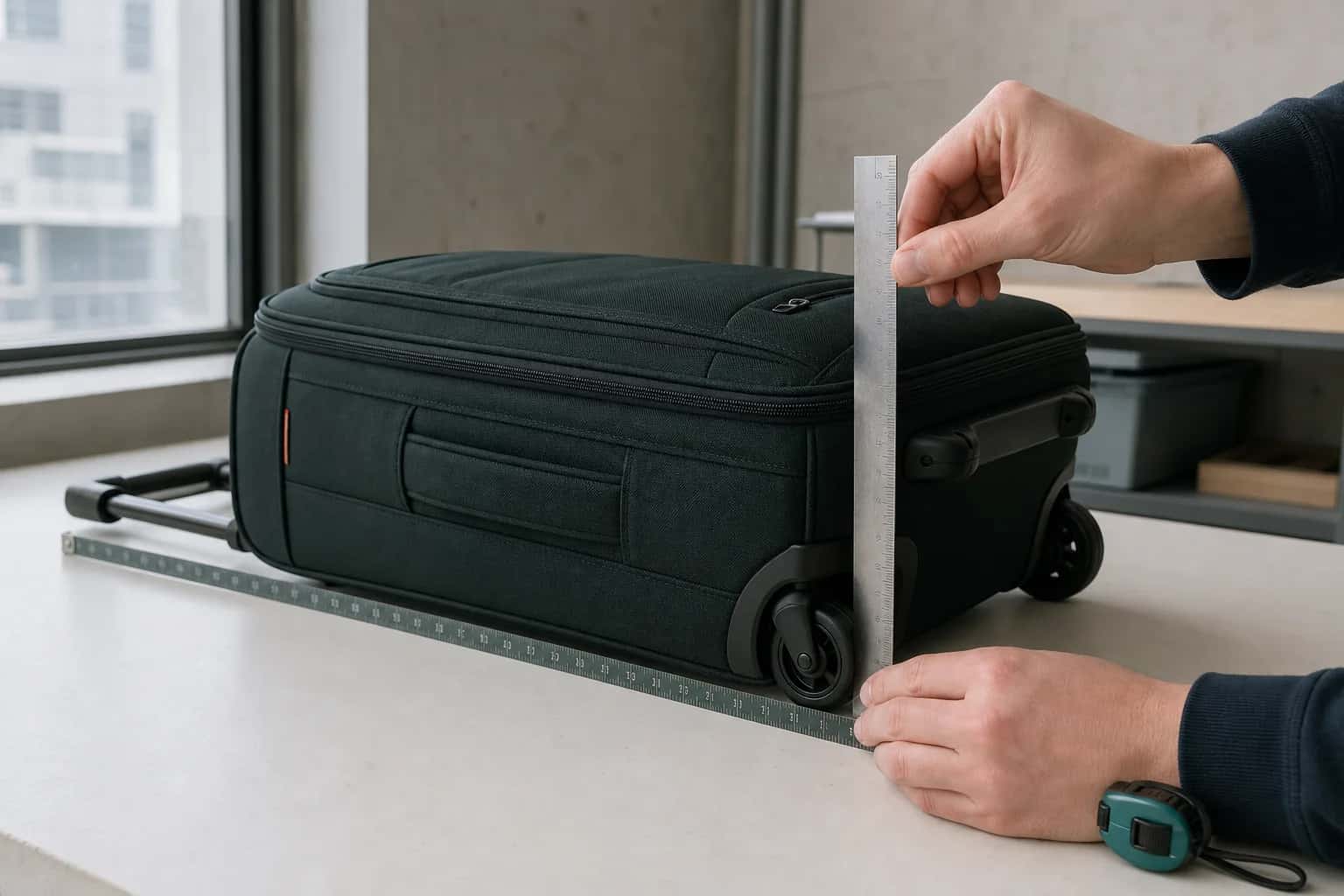
- Always measure the packed bag from its widest outside points, including wheels, handles, and bulging pockets.
- Airline limits are maximums for all three dimensions at once, not a total you can average out.
- Use a marked ruler or tape: 8 inches is 20.32 cm, not exactly 20 cm.
- Turning the bag changes the order of its sides, not their lengths. All three must fit at the same time in one orientation.
Check this guide against your bag
Turn these limits into a real bag check
Enter your packed bag dimensions and compare them with the published airline rule. Choose the airline you are actually flying.
Measuring guide
Measure the packed outside
Include wheels, handles, side pockets, and the shape your bag has when it is full.
- 01Pack the bag first, then measure it.
- 02Check your bag
- 03Compare all airlines
Why careful measuring matters
A soft bag can expand when packed. Measure it with the contents and pockets you will actually take, then compare it with the published rule for your airline and bag category.
Measuring at home helps you spot an oversized bag before leaving. It does not guarantee acceptance: weight, number of bags, ticket allowance and operational conditions are separate checks.
What counts as a dimension
Record the full outside height, width and depth first. Compare like with like: if an airline explicitly excludes wheels or handles, also record the body measurements separately and follow its published method.
- Wheels and spinner casters — measure to the outermost point of the wheels, not the hard shell.
- Telescopic and top handles — include any handle that does not fully retract or fold flat.
- Front and side pockets — measure them full, since a laptop or water bottle pushes the depth out.
- Straps, buckles, and compression clips — tuck or fasten them the way they will sit in the overhead bin.
Inches or centimeters — convert correctly
Airlines publish limits in different units depending on the region. US carriers usually list inches; most European, Asian, and Middle Eastern carriers list centimeters. To compare safely, convert your measurements once and keep both numbers.
One inch is exactly 2.54 cm. Therefore 18 × 14 × 8 inches is 45.72 × 35.56 × 20.32 cm. Do not replace those measurements with 45 × 36 × 20 cm when deciding whether a bag fits. A 22-inch side measures 55.88 cm and exceeds a 55 cm limit by 0.88 cm.
Common measuring mistakes
These errors can lead to comparing the wrong measurements:
- Measuring the bag empty or half-packed, then traveling with it full.
- Reading only the hard shell and ignoring wheels or a protruding handle.
- Averaging the three sides instead of checking each one against the limit.
- Comparing a centimeter bag to an inch limit without converting.
- Trusting the manufacturer's cabin-approved label without checking your specific airline and fare.
Step by step
- 1
Pack the bag as you will travel
Pack the contents you plan to take, including outside pockets, and close the bag as you will carry it. Measure again if you add items or use an expansion zip.
- 2
Stand it upright on a flat floor
Place the bag on a hard, level surface against a wall. This gives you a stable reference for vertical measurements and stops the tape from sagging.
- 3
Measure height, width, and depth at the widest points
Run a tape measure from the floor to the highest fixed point for height, then across the widest points for width and depth. Always measure to the outer edge of wheels, handles, and full pockets.
- 4
Check the airline’s measuring method
Keep the full outside measurements. If the official source distinguishes the body from wheels and handles, record both separately; read the checker’s measurement note before interpreting the result.
- 5
Convert to the airline's unit
If your airline lists centimeters and you measured in inches (or vice versa), convert each side using 1 in = 2.54 cm and write down both numbers.
- 6
Compare every side to the limit
Check all three sides in the same orientation using the airline’s measuring method. If none fits, repack and measure again or choose another bag. Check weight, ticket allowance and any checked-baggage arrangements separately before leaving.
Airlines covered in this guide

Ryanair
- Personal Item
- 40 x 30 x 20 cm
- Basic, included
- Carry-on
- 55 x 40 x 20 cm
- Check fare conditions
- Max 10 kg

easyJet
- Personal Item
- 45 x 36 x 20 cm
- Standard, included
- Max 15 kg
- Carry-on
- 56 x 45 x 25 cm
- Check fare conditions
- Max 15 kg

Wizz Air
- Personal Item
- 40 x 30 x 20 cm
- Basic, included
- Max 10 kg
- Carry-on
- 55 x 40 x 23 cm
- Check fare conditions
- Max 10 kg

Turkish Airlines
- Personal Item
- 40 x 30 x 15 cm
- Economy / Business, included
- Max 4 kg
- Carry-on
- 55 x 40 x 23 cm
- Economy, included
- Max 8 kg

Lufthansa
- Personal Item
- 40 x 30 x 15 cm
- All listed cabins, included
- Carry-on
- 55 x 40 x 23 cm
- Check fare conditions
- Max 8 kg

British Airways
- Personal Item
- 40 x 30 x 15 cm
- Standard, included
- Carry-on
- 56 x 45 x 25 cm
- Standard, included

Ethiopian Airlines
- Personal Item
- Check fare conditions
- Varies by fare
- Carry-on
- 55 x 40 x 23 cm
- Economy, included
- Max 7 kg

LOT Polish Airlines
- Personal Item
- 40 x 35 x 12 cm
- Check fare conditions
- Max 2 kg
- Carry-on
- 55 x 40 x 23 cm
- Check fare conditions
- 8 / 9 kg per piece (by cabin)

EVA Air
- Personal Item
- 40 x 30 x 10 cm
- All listed cabins, included
- Carry-on
- 56 x 36 x 23 cm
- Economy / Premium Economy, included
- Max 7 kg

Egyptair
- Personal Item
- Check fare conditions
- Varies by fare
- Carry-on
- 55 x 40 x 23 cm
- Economy, included
- Max 8 kg
Primary sources
Frequently asked questions
Start with the full outside size. Wizz Air publishes an exception: its dimensions exclude handles and wheels, and wheels may add at most 5 cm. Record the body and total size separately and check the official source; do not automatically subtract 5 cm or add 5 cm to every limit.
Always measure it packed the way you plan to travel. Soft bags and backpacks expand when full, and the packed size is what the gate sizer and overhead bin actually have to fit.
There is no universal 1 cm tolerance. For example, a rigid 55 × 40 × 21 cm bag does not fit a 55 × 40 × 20 cm limit in any orientation. If the bag is soft, remove some contents and measure again; do not assume you can force it into the sizer.
Treat the label as a starting point, not a guarantee. Check the published dimensions, measuring method, weight and allowance for your specific airline and fare.
CabinFit compares published dimensions only and does not guarantee airport acceptance. Always confirm with your airline before you travel.